Tuesday, March 11, 2014

Showcase Presents: Martian Manhunter, Vol. 1


Showcase Presents: Martian Manhunter, Vol. 1 collects the Detective Comics Martian Manhunter stories from his first appearance in #225 (Nov 1955) to #304 (Jun 1962), as well as a story from Batman #78 (Aug-Sept 1953) called "The Manhunter From Mars!" which featured Batman and Robin teaming up with a bad martian to capture a good one. The Martians in that story don't have much in common with the Martian Manhunter though. It seems like they just threw it in because they thought more people would buy a book with Batman in it.


The first Martian Manhunter story has "world-famous scientist" Dr. Erdel create a "robot brain" to explore new frontiers in science. Despite being the one who built it, he somehow doesn't know what it will actually do, so he is startled when:


Not just his thoughts but his worrrrds. Wait, what?

Dr. Erdel can't send him back because it would take time to "reverse the thinking plot of the brain." The Martian, J'onn Jonzz, takes the fact that he is indefinitely stuck on an alien planet pretty well, and immediately assumes human form. It's too much for Dr. Erdel though, who promptly has a heart attack and dies. J'onn J'onzz sets out to explore his new home and finds that:


I guess the "Great Evolution" must not have been permanent, because Martian criminals make multiple appearances throughout these stories.

J'onzz decides that while he is stranded on Earth, he might as well do what he can to fight crime. Walking into a police precinct, he is seemingly hired immediately, and begins his career posing as the human detective, "John Jones."

The plot holes, gaps in logic, and skipping directly from one plot point to the next are pretty typical for the stories in this volume. It's to be expected when the stories are only six pages long for the majority of the book. About two-thirds of the way through, they gain a page, then jump up to twelve pages for the last few, but by then the formula is set. All the stories except the Batman one are written by Jack Miller and illustrated by Joe Certa.

A typical story will involve either John Jones tracking a criminal, or investigating something else that inevitably leads to the discovery of a criminal scheme of some kind. He then uses completely ridiculous tactics to dispatch the evildoers. As with the Superman books, a lot of story ideas are repeated here, like Jones losing his powers, or humans gaining Martian powers. In fact, there are two stories involving a comet passing between Earth and Mars cutting off Jones's powers. The first says the comet "travels between Earth and Mars, once each century, for a full 24 hours," and the second describes an "annual two-hour period," while just eight months passed between the stories in real life.

Speaking of inconsistency, among J'onzz's powers are flight, invisibility, intangibility, shape-shifting, "Martian vision" (which let's him see through objects, among other things), and countless other abilities that change depending on the requirements of the story. He is particularly fond of tunneling underground to get ahead of others without them seeing him. Sometimes he can simply will himself from one place to another, which raises the question, "Why can't he just will himself back to Mars?" Early on, he can even control matter around him through sheer willpower, which seems like it should also provide a way back to Mars if J'onzz would just stop to think about it. Among his most absurd of powers is his super-breath:


The only thing that might beat that out is his "Martian angle vision," a power that only pops up once, makes no sense, and is pointless anyway because he can already see through walls:


Initially, he can only use his powers when invisible, which means no one is even aware of the existence of a Martian on Earth for a large portion of the book. However, Jones does go from visible to invisible and back right in front of people all the time:


I love the fact that he just doesn't care if people are around to see, or how he'll use his ability to walk through walls to capture criminals and just leave them baffled as to how he did it.

It isn't until a criminal Martian arrives and begins wreaking havoc that J'onzz is himself revealed:


The bad Martian's name is B'rett. In another story, J'onn's brother, T'omm, shows up. I like to think his parents were named D'add and M'omm.

It's probably not a coincidence that this story came out shortly before the first appearance of the Justice League of America. It would have been weird having J'onn J'onzz have to be invisible all the time while working with the rest of the team. As usual for individual characters' stories of the time however, there are no references to the League whatsoever.

On the writing side, there isn't a lot of characterization here. J'onn J'onzz occasionally bemoans his fate and longs to return to his home world, but if anything, he has even less character than typical superheroes of the time. The same goes for his superior, Captain Harding, who appears in almost every story.

There is one other character that makes return appearances: Diane Meade, the police commissioner's daughter, who just happens to have a thing for Jones. She first shows up fairly early on, but doesn't become a recurring character until later, and proves to be J'onn J'onzz's unintentional nemesis. In fact, her debut is in a story called "John Jones' Female Nemesis," and her next appearance is called "John Jones' Pesky Partner." 

Here she is trying to beat another policewoman to a medal: 


What a bitch, right? But it gets even better:


That is just golden.

Her being around only makes Jones have to be extra careful to keep his powers hidden, but of course she eventually tries to prove her suspicions that he is the Manhunter from Mars. It seems to me it would actually be easier for Jones to simply reveal himself to the public, but '50s-early '60s DC comics aren't known for breaking tradition (or for logic). Luckily, Jones's powers can cover for pretty much anything, no matter how ridiculous:


You may have noticed the reference to fire as a Martian weakness. Before reading these comics, I thought that was a lame weakness, because of course fire would be harmful. It would be like saying Spider-Man's weakness is being shot in the face. But it's a lot more than that--even lighting a match is enough to send J'onzz into sweating, shuddering paroxysms of fear. Hell, look at this:


On the art side, things are serviceable. There's probably more detail put into the backgrounds than these stories deserve, but characters floating in front of blank white space would be boring to look at. As you can see from the panels above, Joe Certa's style is somewhat cartoony, which fits with the goofy nature of the stories. He has a tendency to give characters huge chins when drawn from the side, which is a bit strange. 

J'onzz's Martian appearance changes gradually over the course of the book. Early on, he has a more alien, almost ape-like, face:


Later, he, and any other Martians that appear in the stories, become more human looking, as seen on the cover.

At this point, I'm going to introduce a new section to these reviews, called:

Monster watch

Being that I am obsessed with monsters and dinosaurs, here I will showcase any creatures that appear in these books.

Unfortunately, there's not much to talk about in this case. We do get a story where J'onn J'onzz gets sucked into another dimension and comes across this rhinosaurus-thing:


Later in the same story, we have a pack of dinosaurs:


And that's it for the cool stuff. Elsewhere, uh…there's these "Martian mandrills," struttin' their stuff like they own the place:


And another story gives us these robot replications of Martian creatures:


And to avoid too much disappointment in the first entry of Monster Watch, here's J'onn J'onzz beating up a lion. Doesn't quite fit in with those others, but I'll take what I can get:


Hopefully next time's Monster Watch'll be better.

While there is quite a bit of goofiness to be found in this book, it doesn't compare to the Superman volumes, and with nothing historically important outside of the Martian's first appearance, there's really no other reason to recommend it. Unless you're a die-hard Martian Manhunter fan for some reason, you won't get anything more out of this one than a few laughs.

Monday, February 17, 2014

Showcase Presents: Supergirl, Vol. 1

Showcase Presents: Supergirl, Vol. 1 cover

Showcase Presents: Supergirl, Vol. 1 reprints the character's initial installments in her ongoing series within Action Comics, as well as her earliest appearances in various other concurrent titles. Included are stories from Action Comics #252 (May 1959) through #282 (Nov 1961), Superman's Pal Jimmy Olsen #40 (Oct 1959), #46 (Jul 1960) and #51 (Mar 1961), Superman's Girl Friend Lois Lane #14 (Jan 1960), Superboy #80 (Apr 1960), and Superman #139 (Aug 1960), #140 (Oct 1960) and #144 (Apr 1961), as well as the earlier Superman #123 (Aug 1958), which presented a story involving a "Girl of Steel" named "Super-Girl" conjured up by Jimmy Olsen using a "magic totem," whose hairstyle is curiously completely different on the cover than in the actual story:


I won't spoil why she never makes another appearance after that issue, but she doesn't. The story was used to gauge reader interest in stories about a female counterpart to Superman, and 9 months later, Supergirl was born. It should be noted that that story, as well as several others in this volume, also appear in the Showcase Presents: Superman volumes.

First, a brief intro on the character: Supergirl is Superman's teenage cousin Kara.

How can that be, you ask? Krypton exploded when Kal-El was but a babe, did it not? How can it be that Kara is a teenager, while Kal-El is fully grown? What be this filth?! I shall read not one blasphemous word farther! Such garbage be not for the likes of me! 'Tis naught but a load of shit!

Well, calm down. Despite DC having a tradition of blatantly disregarding continuity, this seeming inconsistency is indeed rectified, albeit in typically absurd DC Silver Age style:


However, like other pieces of the planet outflung by the explosion, the chunk turns to Kryptonite. Luckily, Zor-El has a rolled up sheet of lead in his lab (for some reason), that they (somehow) use to cover the entire area, blocking out the harmful radiations.

Meanwhile, Zor-El sticks it to his unnamed wife, resulting in the birth of Kara. When a meteorite swarm destroys the lead barrier, exposing the deadly Kryptonite, the now teenage Kara is sent off in a rocket to Earth, where she and her parents had previously observed Superman via "Super-Space Telescope" (a normal telescope wasn't good enough, I guess).

Superman decides she needs to keep her powers secret until she gets enough practice with them, and that she will live in an orphanage. I know it wasn't intentional, but a lot of the time it seems like Superman is cruelly taunting Supergirl. He brags to her, "In my youth in Smallville, I was honored as Superboy!" and says "You too can gain fame as Super-Girl [sic], the girl of steel!" But then he tells her she has to wait to use her powers in public until he says it's okay, and that she has to live in an orphanage instead of living with him. Then he goes on and makes her do something that makes no sense:


If she's not allowed to let anyone see her using her powers anyway, what in hell is the point of her wearing a wig? Did she not look like an Earth girl to him before? And doesn't he think it would increase the chances of people suspecting something about her if she always had to be worrying about her wig?

She chooses the name Linda Lee, and Superman muses, "Lana Lang was my girl friend when I was Superboy, and Lois Lane replaced her when I became Superman! By sheer coincidence, she picked the initials…L.L.!" As I mentioned in my review of Showcase Presents: Superman, Vol. 2, the pattern with the initials "L.L." is directly addressed often, but never explained.

Superman then sets her up in Midvale Orphanage, explaining to them that she "lost her parents in a big disaster that wiped out her whole community."

From there, the stories involve Linda getting into lots of situations that require her to use her powers in secret, while still changing into her Supergirl outfit when she does so for no particular reason. She often has adventures in the past or future, where she "doesn't have to hide her powers." Of course not hiding her powers makes no sense for the past, as she finds out:


Not that she learns anything from that, judging by later stories. Here she is helping to commit genocide:


I'm kidding, she doesn't actually kill anybody.

Her arch-nemesis is Getting Adopted, and she often has to come up with ridiculous ways to avoid it, such as:


So not only does she have to live in an orphanage, but she can't even get adopted because people might find out who she is. And of course she also has to deal with other kids at the orphanage suspecting who she is. My favorite scene comes when she tries to throw off suspicion at one point:


I don't know if even Superman could have pulled that much craziness off. The whole turning-coal-into-a-diamond thing does come up all the time in both these stories and the Superman ones though.

Partway through, Linda gets a robot of herself that hides in a tree near the orphanage and comes out to take her place when she has to go off to use her powers elsewhere. That seems like it would only cause more problems, but whatever.

Apart from Linda and Superman, there are a few other recurring characters, none of them people at the orphanage oddly enough.


First up is Streaky, the Super Cat, who gets powers from, depending on the story, either the radiations or the fumes given off by X-Kryptonite, a variation of Kryptonite accidentally created by Supergirl when she was experimenting to find an antidote. His powers are only temporary, but he keeps managing to find the piece of X-Kryptonite that Supergirl "super-tossed" into the woods. Neither she nor Streaky realize that that is the source of his powers, despite him getting powers over and over. I will also note here that the thought-voices given to Streaky and other animals, like Krypto, are usually painful to read.


Next, there's Jerro, the mer-boy from Atlantis. 


There isn't much to say about him, other than that he has a fish tail for legs.

There are a few adventures with the Legion of Super-Heroes here, one of which introduces another love interest for Supergirl in the form of Brainiac 5.


He actually only shows up once in this volume, but it's worth noting as his first appearance.

Supergirl has one more "boy friend" here: Dick Wilson, the boy from the orphanage who suspected her identity in those panels with the diamond silliness above. He only shows up that one time at the orphanage though. She doesn't see him again until both of them are adopted (I'll get to her adoption in a bit), when his name is now Dick Malverne.


There's nothing to say about Dick either. These are some boring characters. Just look at that panel, they even look the same.

Throughout the book, Supergirl's introduction to the world keeps getting teased, but something always comes up to stop it. It's pretty frustrating to be honest. The best instance is when Supergirl loses her memory due to red Kryptonite and exposes herself in Smallville. Superman goes to extreme lengths to keep his "secret emergency weapon" a secret:


Finally, Superman decides it's time to reveal her existence to the world, and…she loses her powers. It turns out that an evil scientist living in the bottle city of Kandor named Lesla-Lar, who just happens to look exactly like Linda (and also has the initials "L.L."), stole her powers:


She then takes Linda's place and strikes up a deal with Lex Luthor, leaving Linda in Kandor thinking she is Lesla-Lar (if my 'L' key still works at the end of this review, I'll be surprised). It doesn't make a lot of sense and goes on way too long, but that's actually part of what's interesting about it.

Until then, almost all DC superhero stories were one-and-done tales with no permanent effect on future stories. Apart from some 2-part Superman stories in Action Comics, this is the first instance I know of from the era where a story continued across multiple issues. If only it had been a better story. In fact, it doesn't even feel like an ongoing story so much as a temporary change in the status quo. Instead of Linda going back to the orphanage at the end of each story, she goes to her room in her foster parents' home (Superman lets her get adopted after she loses her powers), while Lesla-Lar schemes and points:


After treading water for what feels like forever, the situation is resolved via an unsatisfying deus ex machina, because why should we expect anything more?

There is another particularly interesting story here called "Mighty Maid!" but I already covered it in my review of Showcase Presents: Superman, Vol. 2, so I won't talk about it again.

The stories are written by Otto Binder and Jerry Siegel, with Siegel eventually taking over as the sole writer of the Action Comics Supergirl segments. As usual for the time, there is no discernible difference in their writing styles.

Jim Mooney is the artist for all the Supergirl stories from Action Comics. I'm used to his later work in Amazing Spider-Man at Marvel in the '60s, and his style here is recognizable . He seems to use more blacks and shadows than most artists at DC at the time and avoids the stiffness of artists like Wayne Boring. I would guess he was put on these stories because he can draw pretty girls. I don't really have any complaints with his work, but he does reuse some of the same stock images/positions a lot, like the aforementioned Lesla-Lar evil pointing: 


There's also Linda on her bed: 


Despite a couple of important issues, this volume just isn't that interesting on the whole. And as those particular issues are also included in the Superman and Legion of Super-Heroes volumes anyway, I'd say that this book, while demonstrating a sign of changes in storytelling to come, ends up being pretty skippable.

Sunday, February 2, 2014

Them! (1954)


A series of mysterious events in New Mexico, including several deaths, is investigated by the local police and the FBI, eventually leading to the discovery of a nest of giant ants, mutated by atomic bomb tests.

I like the fact that this movie starts out as a mystery, even though the poster and trailer give everything away. It's still interesting from the beginning, although they drag it out too much once the requisite scientist is called in, who of course already knows what is behind everything but won't tell anyone until he is 'absolutely sure.'


At the beginning, we have a little girl who is found wandering in the desert in a state of mute shock (Aliens, anyone?). The investigating cops find a destroyed trailer home and a weird print in the sand nearby, then a wrecked store, its owner dead and later found to have "enough formic acid in him to kill twenty men".

The cops hear a weird sound--almost like a squeaky siren, with what sounds like bird sounds behind it--and the one left behind to guard the store is killed by something strong enough to take four bullets from his gun and still get away.

The FBI send in agent Robert Graham (James Arness, the title character in The Thing [1951]), and a cast of the print found by the cops attracts the attention of an entomologist (Edmund Gwenn) and his daughter (Joan Weldon, who, in a pleasant surprise, is also a scientist, and not the typical woman-in-peril or love interest).

The scientist uses the smell of formic acid to bring the little girl out of her stupor, causing her to begin screaming "THEM! THEM!" over and over. (Inexplicably, they leave right after that instead of trying to get her to tell what she saw--maybe because they couldn't stand her screaming?)


"THEM!! THEM!!!!" "We heard you the first time, now SHUT UP!!!"

When the dead cop's former partner and Agent Graham accompany the scientists to the location of the print, they hear the weird sound again. This time, a giant ant pops up from over a ridge. The elder entomologist tells them to go for the annentae, which slows the ant down long enough for it to be pumped full of bullets from a machine gun.


Whatever happened to 'short, controlled bursts'?

From there, the team track down the nest and destroy it, but discover that a pair of newborn queens have escaped and must search out the new colonies before more queens are born.

The acting, above-average for this type of film, and foreboding atmosphere make what could be a boring start interesting. The visual of the strong winds blowing across the desert gives those scenes a uniquely eerie quality. Unfortunately, apart from a tiny scene with the second nest, which ends up being no more than a footnote, the film drags after the destruction of the first nest and doesn't really pick up again until the very end. It just takes too long to find the last nest.

The investigative techniques of the FBI agent in trying to find the new nest don't make a lot of sense either. He interrogates people who have been arrested/received speeding tickets recently with the hope that their actions may have been a result of seeing giant ants...yeah... I suppose it's true that he didn't have any leads to go on, but I would think physically going out and searching for them would be the best course of action, right? But hey, I'm not an FBI agent, so what do I know?


[Insert Wilhelm Scream here.]

At least the ants are cool, surprising for a giant bug movie of the time--or ever, really. It probably helped that this was actually the first movie about giant bugs, as well as one of the first movies to blame nuclear weapons for attacks by monsters (I believe the first was The Beast From 20,000 Fathoms from 1953).

The film was actually nominated for a Special Effects Oscar. The full size ant puppets are mostly effective, although they are a little stiff, and sometimes look like they have pupils for some reason. It's the way they are shot that really makes them work; you see just enough to know what is happening without the camera lingering on the ants long enough for you to pick out any bad movements or physical imperfections.


Burning the egg chamber. Aliens, anyone?

The scenes with flamethrowers being used against them are just plain awesome. I was not at all expecting that real flamethrowers would be employed, much less that they would actually burn the ant puppets.

Interestingly, the film was originally to be in color and 3-D, but problems with the 3-D cameras led to the producers abandoning the idea and trying to ape the success of The Beast From 20,000 Fathoms by making everything (except the title card) black and white; it must have worked--Them! was supposedly Warner Bros.' highest grossing film that year.


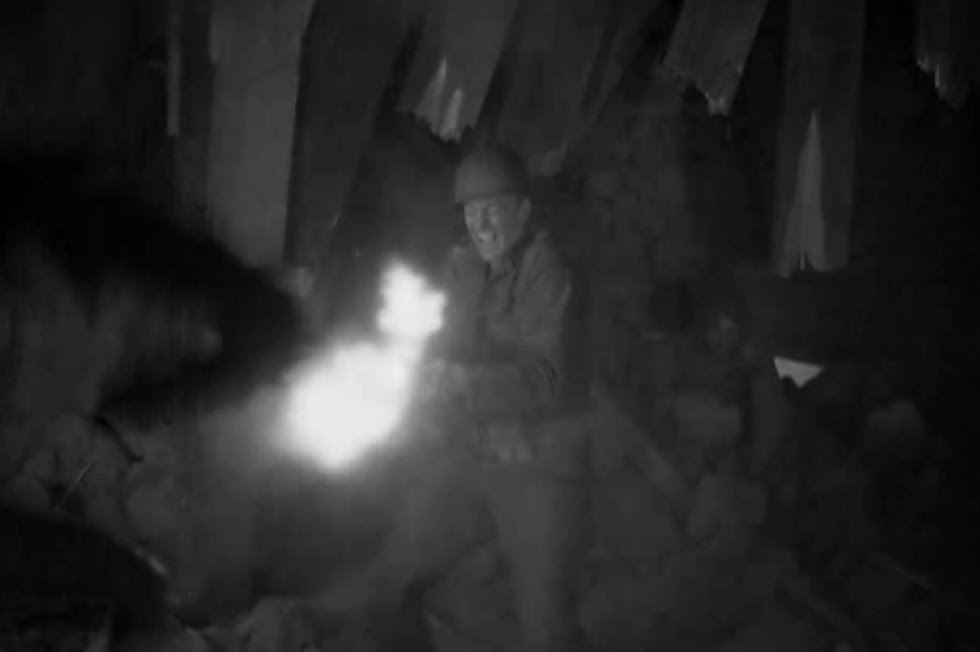
Soldiers in a dark tunnel under attack by giant bugs that seem to appear out of nowhere--seriously, it's just like Aliens.

Despite losing some steam in the middle and having a pretty standard '50s monster story, the cool ant effects, realistic/serious tone, above average acting, and good direction/camerawork make this one of the best movies of its type.